Absolutely Cats
Peterbald Kittens, Peterbald Cat Breeders, Peterbald Cats, Peterbalds
sheila@absolutelycats.com


Home

Breed Lists

New! Kittens New!

Available Retirees

Gallery Of
Cats and Kittens


Today's Photos

Today's Cattery

Adding
Your Cattery

Corrections/Updates

Renewals

See The
Newest Listings


Cattery Banners

The Litter Box From Your Cat's Point Of View

Finding And Buying
A Kitten


Tips For Photographing Cats and Kittens

JUST FOR FUN!
Favorite Cats
Favorite Names
For Cats


CFA
Breed Profiles
Slide Show

GCCF

FIFe

TICA


Peterbald Kittens and Cats

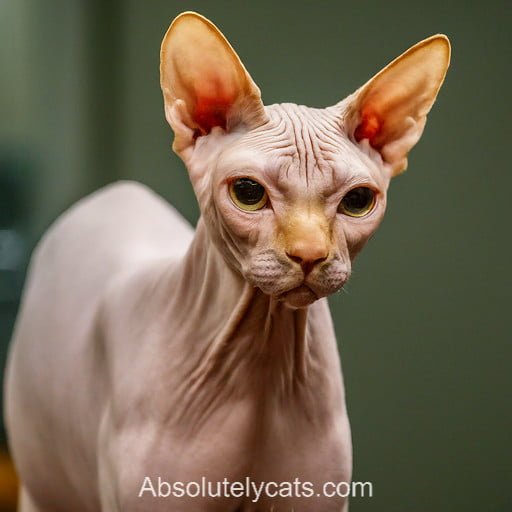
Peterbald kittens and cat have an elegantly slim graceful and muscular build. They have a narrow and long head with a straight profile, almond-shaped eyes, wedge-shaped muzzle, and big set-apart ears. They have a long whippy tail, webbed feet and oval paws that allow them to grasp objects and open levered doorknobs. They are somewhat similar in appearance to Oriental Shorthair cats. They have a hair-losing gene and can be born bald, flocked, velour, brush, or with a straight-coat. Those born with hair, except the straight-coats, can lose their hair over time. Peterbald kittens and cats come in all colors and markings.

The Peterbald breed was created during the latter half of 1994 in St. Petersburg, Russia, the result of an experimental mating of a Don Hairless (also known as Don Sphynx, Donskoy or Donsky) male named Afinogen Myth and an Oriental Shorthair female World Champion named Radma von Jagerhov, by Russian felinologist Olga S. Mironova. The first two litters produced four Peterbald kittens: Mandarin iz Murino, Muscat iz Murino, Nezhenka iz Murino and Nocturne iz Murino. These four Peterbald kittens were the founders of the breed.

In 1996, the breed was adopted in the Russian Selectional Feline Federation (SFF) and given a standard and an abbreviation (PBD). In 1997 it was adopted in The International Cat Association (TICA) with the abbreviation PB, and in 2003 in the World Cat Federation (WCF) with the abbreviation PBD. Other used handles of the breed are PBD, PTB, PD and PSX.

These days the breed develops in the direction of modern Oriental and Siamese types, that is to say a long muzzle, large set-apart ears, flat cheekbones, and an elegant body on long legs. Therefore, all standards for Peterbalds encourage mating with Oriental and Siamese cats and semi-longhair variations of those (such as Balinese and Javanese). The Balinese and Javanese were eliminated from the acceptable outcross list in 2005.

The Peterbald was accepted for Championship class competition, effective May 1, 2009, in the American Cat Fanciers Association (ACFA) in August 2008. Effective May 2008, TICA recognizes the "brush coat" Peterbald for Championship competition.

The most common health issue is gingivitis, and early tooth loss.


From Wikipedia, the free encyclopedia
http://en.wikipedia.org/wiki/Peterbald